Whenever children and the elderly are murdered in large numbers, particularly for political motives, there is always an international outcry. I certainly don't defend such behaviour, whether perpetrated by government forces or opposition. But I could ask in what way the death of a child or an old person is worse than the death of a mother or father, whose children are left without anyone to care for them. I could ask in what way death is worse than survival, maimed and unable to care for oneself. I could ask in what way sudden death by bullet or knife is worse than slow death from starvation and disease in a region crippled by war, famine or poverty. And I could ask why the murder of 32 children deserves international condemnation, but wilful destruction of the future of millions of young people through harsh and misguided economic policies matters not at all.
In a recent report, the International Labour Organisation (ILO) notes that global youth unemployment is almost 75 million, representing 12.6% of the global workforce, and is expected to stay elevated for years to come. It describes a "scarred" generation of young workers facing "a dangerous mix of high unemployment, increased inactivity and precarious work" in DEVELOPED countries, plus persistently high working poverty in the developing world. And in its report produced with input from young people themselves, the ILO notes that the problems young people face in developed countries stem from the 2008 Global Financial Crisis.
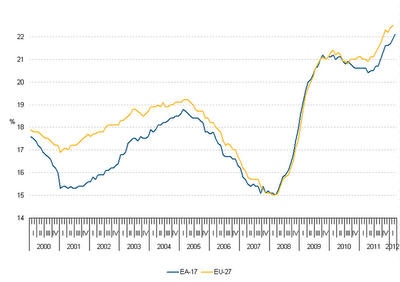
The EU has also produced a useful report explaining its unemployment statistics. Or rather, the report's charts are useful - and horrifying. Here is the trend chart for youth unemployment in the EU itself and in the Eurozone:

I have to say that I find the accompanying textual explanation of youth unemployment trends disgracefully complacent. It suggests that unemployment among young people is now more of a problem in the wider EU, which includes the UK and Eastern Europe, than in the Eurozone. This is what this chart shows, but it is misleading. It is a fine example of what happens when you assume that what is true at the aggregate level also applies to the individual items underlying it - what is known as "fallacy of division". Eurozone youth unemployment rates look better than EU ones not because there is less of a problem but because of massive disparity between youth unemployment rates in the different member states. Youth unemployment levels in Spain and Greece are over 50%, the highest in Europe and among the highest in the world, but this is balanced by much lower youth unemployment rates in Germany. The EU has resorted to abuse of statistics to create an artificially rosy picture of the situation in the Eurozone.
The accompanying table of youth unemployment ratios by country (the proportion of total unemployed that is made up of young people) also shows increases since 2008. So not only has youth unemployment risen as a consequence of the financial crisis, young people were - and are - disproportionately affected by it. Adults are finding work at the expense of young people. This is consistent with the findings of the ILO quoted above. And the ILO's report talks about disillusioned young people, unable to find work, experiencing health problems, drug and alcohol abuse. Unemployment early in life can set a pattern for the whole of life. It is known that prolonged unemployment among adults leads to skills loss, which makes it harder to get employment: but in young people prolonged unemployment prevents them developing the skills in the first place and sets up a pattern of inactivity that may make them unemployable. Persistent, lifelong unemployment devastates families, ruins health and shortens lives. And study after study has demonstrated links between unemployment, poverty and violence. This one, by Danny Dorling at the University of Sheffield, shows clearly how murder rates rise as poverty increases (h/t Dr. Anne Brunton).
The failure of the leaders of European nations to deal adequately with the 2008 financial crisis and its aftermath has blighted the future lives of an entire generation. How is this any better than the murderous behaviour of the Syrian regime? How dare the leaders of countries that, through their failure to manage their economies to the benefit of their people, are wrecking the lives of millions of young people, condemn the behaviour of a regime that may have murdered thirty-two? Such hypocrisy beggars belief.
And what appals me the most is that there is still no change in the economic policies that have brought about this situation. The Eurozone leadership refuses to act either to end Greece's agony or to bring relief: the UK leadership continues to pursue policies that will increase unemployment: the Spanish and Irish leadership still give higher priority to bailing out banks than ensuring that their young people have a future. The EU leadership talks about policies to address youth unemployment. But so far it has done very little, and if the rhetoric in the Unemployment Trends report is anything to go by, it is not clear that it really recognises the nature of the problem. It notes that the Employment Policy Guidelines (2008-10) encouraged member states to:
- work with renewed endeavour to build employment pathways for young people and reduce youth unemployment, in particular, through adapting education and training systems in order to raise quality, broaden supply, diversify access, ensure flexibility, respond to new occupational needs and skills requirements, and;
- take action to increase female participation and reduce gender gaps in employment, unemployment and pay, through better reconciliation of work and private life and the provision of accessible and affordable childcare facilities and care for other dependents.
But the 2008 financial crisis wasn't about skills, it wasn't about gender gaps and childcare, it wasn't about work/life balance. It was an economic crisis that destroyed jobs and opportunities across Europe. And it is STILL an economic crisis destroying jobs and opportunities across Europe. The Europe 2020 report bewails the fact that the "crisis has wiped out recent progress". And it comes up with lots of lovely ideas for improving education, investing in R&D, extending employment participation, encouraging "green" initiatives and lifting people out of poverty. Fantastic. But unless the EU can find a way of ENDING THE CRISIS, none of these will happen.
As long as the leaders of European nations continue to pour money into insolvent banks and wreck their economies in order to prop up a dysfunctional financial system and a failed currency experiment, economic activity in much of Europe will continue to decline and youth unemployment will continue to increase. And they will be as guilty of murder as the Syrian regime - but on a much, much larger scale.